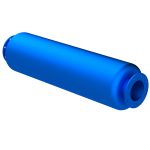
Silencer Sizing

Positive Displacement blowers have two impellers that trap a “pocket” of air each time they sweep by the inlet and discharge connection. A pressure pulse is created each time this occurs. This pressure pulse creates noise and vibration. Blower silencers can be used to reduce this noise and vibration.
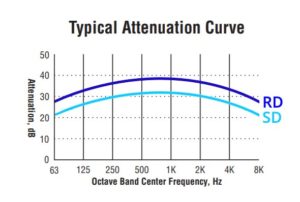
Blower silencer attenuation curve

Silencers are typically used on the inlet and discharge of a positive displacement blower used for pressure applications. A discharge silencer is typically used on a vacuum application.

There are three basic types of silencers used to reduce the noise and vibration generated by the pressure pulse: Chamber Type, Chamber Absorptive Type, and Absorptive Type. Click to read more about the differences between these silencer types.
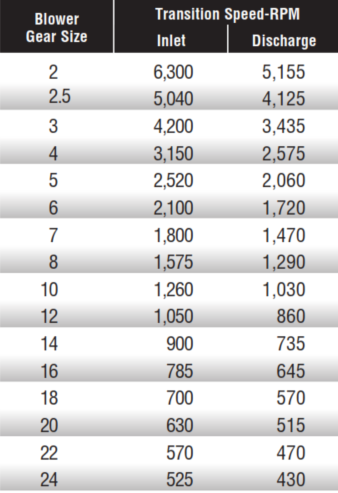
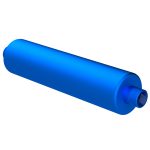
Choosing the Silencer Type

silencer blower transition speed chart(If in doubt, use Chamber-Absorptive)

The normal criterion for silencer type selection is the Pitch Line Veloctiy (PLV) of your blower system. PLV is the peripheral velocity of the timing gear, equal to the product of the gear circumference and the rotative speed of the blower, usually expressed in feet per minute (FPM).  For purposes of silencer application, PLV is considered “critical” at 3,300 ft/min for intake and 2,700 ft/min for discharge.

The Blower Transition Speed table gives transition speeds in RPM. Blowers running at these speeds or greater will have critical PLV. Operating speeds below transition will be in the sub-critical range. Blowers operating in the sub-critical speed range usually require only simple chamber-type silencers while those in the critical range require combination chamber-absorptive type silencers. If there is doubt, it is best to use the combination-type silencers. When gear size and operating speeds are known, the proper type silencer is easily selected.

Selecting the Silencer Size

The Silencer Capacity table below gives the nominal capacity of the various size silencers. “Size” in this table refers to the silencer “nominal size” or its “inlet size”. Capacities are expressed in inlet CFM (ICFM), thus discharge silencers are rated at higher capacities than inlet silencers since the air is compressed to reduced volume at the discharge operating pressure.

Always make sure to use the Actual CFM (ACFM) for your application when selecting equipment instead of standard (SCFM). Click here for more details about the difference and a calculator to convert SCFM to ACFM.

Silencer Capacity based on Inlet CFM 14.7 PSIA at 70°F


SizeINLET SILENCERDISCHARGE SIL.
4 psig
DISCHARGE SIL.
6 psig
DISCHARGE SIL.
8 psig
DISCHARGE SIL.
10 psig
DISCHARGE SIL.
15 psig
1303540404045
1.57080859095105
2120140150160165185
2.5190220235245255285
3270320335355370415
3.5370430455480505560
4480560600630660735
57508809359851,0301,150
61,0801,2601,3401,4101,4801,650
81,9202,2502,3902,5102,6302,940
103,0003,5203,7303,9304,1104,590
124,3005,0705,3705,6605,9206,600
145,9006,8907,3107,7008,0608,990
167,7009,0009,55010,00010,50011,800
189,70011,40012,10012,70013,30014,900
2012,00014,00014,90015,70016,40018,400
2214,50017,00018,10019,00019,90022,200
2417,30020,20021,50022,60023,70026,400
2620,30023,80025,20026,60027,80031,000
2823,50027,60029,30030,80032,20036,000
3027,00031,70033,60035,40037,00041,300
Est. Temp.70°F115°F140°F165°F190°F240°F

Blower Silencer Selection Examples

Here are several different examples that all feature a 45 URAI blower driven by a 10hp motor. The 45 URAI has a 2.5″ inlet connection and is rated for a maximum airflow of 395 CFM. All of these example pressure packages have a configuration we refer to as P2 which includes a filter and a silencer before the blower inlet, followed by a silencer, relief valve, and check valve underneath the mounting base on the discharge side of the blower.

For this application the air volume at the inlet will be 154 ACFM. If we refer to the table above we can see that a 2.5″ inlet silencer can handle up to 190 CFM of flow. With the reduced airflow of 122 ACFM at the discharge, a smaller silencer could work but we have used another 2.5″ silencer that matches the 2.5″ connections of the blower and the customer’s piping.

Operating conditions:
Inlet Volume: 154 ACFM (150 SCFM)
Site Elevation: 0′
Barometric Pressure: 14.7 PSIA
Inlet Temperature: 65°F
Inlet Pressure Drop: 0.3 psi
Discharge Pressure: 7 psig
Discharge Pressure Drop: 0.2 PSI
Blower Differential Pressure: 7.5 PSI

Design Speed 1848 RPM (51% of maximum)
Shaft Power: 7.7
Discharge Temperature: 173°F
Temperature Rise Across Blower: 108°F
Discharge Volume: 122 ACFM

In the next package we have more flow entering the system at 208 ACFM. Referring back to the table again, we can see that this is over the max for the 2.5″ silencer so we now need to bump up to a 3″ model which can handle up to 270 CFM. For the discharge silencer on this package we need to account for 166 ACFM at 6 PSIG so the 2.5″ silencer will be adequate.

Operating conditions:
Inlet Volume: 208 ACFM (180 SCFM)
Site Elevation: 500′
Barometric Pressure: 14.4 PSIA
Inlet Temperature: 100°F
Inlet Pressure Drop: 0.3 PSI
Discharge Pressure: 6.0 PSIG
Discharge Pressure Drop: 0.2 PSI
Blower Differential Pressure: 6.5 PSI

Design Speed: 2,284 RPM (63% of maximum)
Shaft Power: 8.4 BHP
Discharge Temperature: 193°F
Temperature Rise Across Blower: 93°F
Discharge Volume: 166 ACFM

In our final example we have an airflow of 300 ACFM at the inlet. Per the table, a 3.5″ silencer would be adequate but that is not a commonly used—or stocked—size so at the inlet we have selected a 4″ silencer which can handle up to 480 CFM.  At the discharge, where we expect only 253 ACFM flow at 4 PSIG, a 3″ silencer has been selected.

Operating conditions:
Inlet Volume: 300 ACFM (265 SCFM)
Site Elevation: 0′
Barometric Pressure: 14.7 PSIA
Inlet Temperature: 100F
Inlet Pressure Drop: 0.3 psi
Discharge Pressure: 4.0 psig
Discharge Pressure Drop: 0.2 psi
Blower Differential Pressure: 4.5 psi

Design Speed 2945 RPM (82% of maximum)
Shaft Power: 7.9
Discharge Temperature: 160°F
Temperature Rise Across Blower: 60°F
Discharge Volume: 253 ACFM

Want to keep learning about component selection?  Check out our article on how to select a blower filter.

Griffin Moore
AUTHOR
Griffin Moore

Related Articles

Types of Blower Silencers

Blower silencers are used to reduce both noise and vibration. Learn about the differences between Chamber, Absorptive, and Chamber-Absorptive silencers to identify the silencer that is right for your application.

Read More

Blower Silencer Comparison

To select the right silencer for your pressure or vacuum application, the two important criteria are the silencer type and the silencer size. This page covers the series of blower silencer available.

Read More